Page Created by Connecticut Foraging Club
Upcoming Events | Meet the Instructors | Plant Archive | Mushroom Archive
----------------
Upcoming Events | Meet the Instructors | Plant Archive | Mushroom Archive
----------------
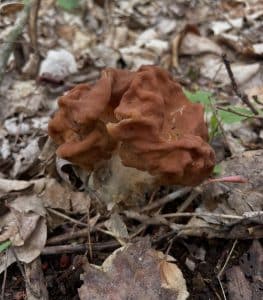
Maublancomyces korfii (Snow false morel) is a look alike to true morels (Morchella spp.). Both true and false morels fruit in the spring.

The snow false morel can be found growing under hardwoods. It is saprobic and potentially also mycorrhizal.
Some false morel mushrooms have the toxin gyromitrin, which becomes monomethyl hydrazine (MMH) when consumed. MMH can cause dizziness, diarrhea, and vomiting. It is also carcinogenic. Some mushrooms contain enough MMH to be deadly. Levels of MMH vary by species and geographic location.
MMH is a cumulative toxin, meaning it builds up in your body with repeated consumption. It is also released into the air when cooking mushrooms containing gyromitrin so even breathing in the fumes while cooking these mushrooms can cause toxic effects.
The snow false morel has a brownish, blocky cap with a chambered inside. It has a large, white stem. This species is no longer thought to contain the toxin gyromitrin but still needs to be thoroughly cooked before consumption.
There have been no reports of poisonings from consuming properly cooked snow false morels in North America.
Those who consume snow false morels prepare them similarly to true morels and report a meaty flavor.

False morels could be confused for true morels. False morels have wavy or lobed caps. True morel caps are more uniformly shaped with pits. False morels are filled with chunks of tissue, while true morels are hollow.
Snow false morels can be confused for the most toxic of the false morels, the beefy false morel (Gyromitra esculenta) which has a more wrinkled, brain-like, and darker brown cap. The stem is narrower and colored. It associates with conifers. There have been some studies linking the consumption of Gyromitra esculenta with the development of ALS.
--
Written by Amy Demers, founder of the Connecticut Foraging Club. To learn more about foraging in Connecticut, check out our upcoming classes.